REVIEW · TANGIER
7 days Tour from Tangier to Marrakech Morocco Tours
Book on Viator →Operated by Destino Marruecos - Day Tours · Bookable on Viator
Blue Morocco to the Sahara in one week.
This Tangier to Marrakech trip works because it strings together imperial cities, desert scenery, and UNESCO-era sights without wasting time. I like that you get a real rhythm to the day—hotel pickup, guided city blocks, then big driving segments that actually put you where you need to be. A group max of 17 people also keeps it friendly, not chaotic.
I’m also a fan of the built-in structure: you sleep in traditional riads for six nights, then swap to a luxury desert tent for one night. In places like Fes and Marrakech, the sightseeing is guided, so you’re not just wandering in the medina maze wondering what you’re looking at.
One thing to consider: lunches and dinners in Chefchaouen, Fes, and Marrakech are not included, and some entrances (like Volubilis) cost extra. If you want a fully “all-in” price with zero add-ons, you’ll need to budget a bit beyond the tour cost.
In This Review
- Key takeaways before you go
- Tangier to Marrakech: a one-week route that actually connects the dots
- Chefchaouen Medina and the Rif drive: blue streets and early momentum
- Volubilis and Meknes en route to Fes: Roman ruins plus a 17th-century wall
- Fes el-Bali guided souks: getting oriented before the medina eats your schedule
- Ifrane, cedar forests, and the palm oasis: cooler air, apes, then desert preparation
- Erg Chebbi dunes overnight: camel ride, sandboarding, and camp under the stars
- Rissani, Todra Gorge, and Dades Valley: markets, stone cliffs, and fig-country vibes
- Ouarzazate, Skoura palms, Aït Benhaddou, then up and over the Atlas into Marrakech
- Marrakech medina time: Jemaa el Fna, Saadian Tombs, Bahia Palace, and Koutoubia
- Price and logistics: does $1,349.08 feel worth it?
- Who this tour suits best
- Should you book this Tangier to Marrakech tour?
- FAQ
- What time is pickup on the first day?
- How long is the tour?
- What is the group size limit?
- Is there a camel ride and desert camp included?
- Is sandboarding included?
- What about transport to and from the desert camp?
- Are meals and entrance tickets included?
- What’s the cancellation rule?
Key takeaways before you go
- Small group size (max 17) keeps the trip manageable and questions easier to answer.
- 6 riad nights + 1 desert night gives you both city life and Sahara-style nights.
- Erg Chebbi dunes experience includes camel ride, sunset, and sandboarding.
- Guided Fes el-Bali and Marrakech city time helps you navigate the medina streets with less guesswork.
- Comfort options around the desert include a 4×4 transfer alternative to camels.
- UNESCO-style stops like Volubilis are included in the route, even if entry fees may be extra.
Tangier to Marrakech: a one-week route that actually connects the dots
If you’re short on time but want Morocco’s big contrasts—coast, mountain towns, old imperial cities, and the Sahara—this week-long route is built for you. You start in Tangier, move inland through Chefchaouen and the Rif, then push south through Fes and the Atlas before ending in Marrakech.
The smartest part is the pacing: your cities aren’t just drive-bys. You get guided time where it matters (Fes and Marrakech), then you spend the longer blocks on the road when the real payoff is the scenery ahead.
And about the people running it: the driver-guide team is repeatedly described as calm, careful, and good at handling logistics ahead of time. Names like Rachid, Mohamed, Moha, and Ibrahim show up in feedback connected to safe driving and smooth coordination—especially helpful if it’s your first time in Morocco.
You can also read our reviews of more tours and experiences in Tangier.

Chefchaouen Medina and the Rif drive: blue streets and early momentum
Day 1 starts with pickup from the Tangier area and an 8:00 am hotel collection. After that, you’re heading through the Rif mountains toward Chefchaouen, the famous blue-walled medina.
Chefchaouen is best when you slow down for small moments: narrow alleys, doorways, and the way light hits the painted streets. Even if you’ve seen photos, the real value is being there long enough to walk and orient yourself in the maze—without spending half the day trying to find your way.
Practical note: this is a travel-and-walk day. Expect time moving between places, not just one long stroll. If you like a structured start, you’ll like this.
Volubilis and Meknes en route to Fes: Roman ruins plus a 17th-century wall
Day 2 adds Volubilis—Morocco’s best-preserved Roman ruins. This is a strong stop because it breaks the trip out of “city medina only” mode and gives you something clearly ancient and different. Volubilis admission is not included, so you’ll want to allow a little extra for tickets.
After that, you continue to Meknes, where you’ll have lunch and wander the medina walls. Two standouts from the route plan are Bab el Mansour and the tomb of Moulay Ismail. Even with limited time, Meknes feels like a real pause: less frantic than Fes, but still historical and atmospheric.
Then you drive straight to Fes for the night. This is good for efficiency, but if you get travel-fatigue easily, pack light in your day bag and plan to take it easy on arrival.
Fes el-Bali guided souks: getting oriented before the medina eats your schedule
Day 3 is a true medina day in Fes el-Bali, with a guided tour of the old city and its souks. This matters more than it sounds. Fes is large, old, and maze-like; a guide helps you connect architecture, craft areas, and important landmarks so you come away with understanding, not just photos.
You’ll spend about four hours in the guided block, then overnight in a riad. This is one of those travel choices that feels small on paper but makes a big difference: staying in riad-style accommodations in Fes keeps you close to the medina rhythm instead of being stuck on the edge of town.
One more detail worth noting: the route description highlights features like green glass minarets, narrow cobbled streets, and Andalusian-style elements. A guide is the difference between seeing these as random sights and recognizing them as part of a bigger picture.
Ifrane, cedar forests, and the palm oasis: cooler air, apes, then desert preparation
Day 4 starts with a scenic stop in Ifrane, often called the Switzerland of Morocco thanks to its cooler climate and tidy architecture. It’s a brief breather between big city days and the hotter desert atmosphere.
Then you move through the Middle Atlas to the Azrou cedar forest area for Barbary apes. This is one of the moments that can feel both cute and a bit wild—these monkeys are used to people and may approach you during walks. If you want this to go well, follow your guide’s lead on where to stand and what distance to keep.
Next comes a long, visual transition: you reach a large palm oasis with more than 18,000 palm trees spanning over 20 kilometers. It’s a cool shift from mountain textures to desert-edge scenery, and it signals that you’re getting close to the dunes zone.
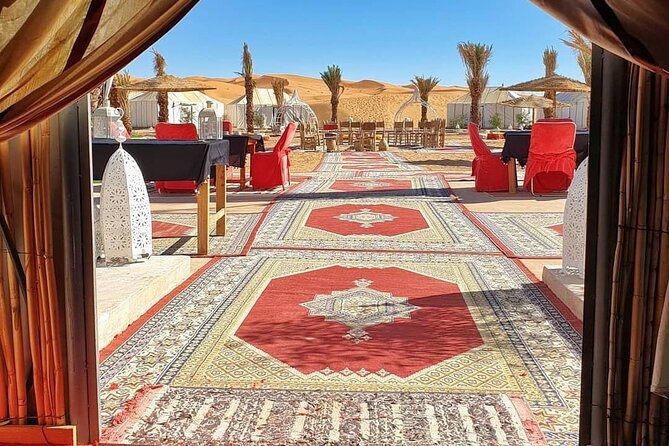
By evening, you head toward Erg Chebbi dunes (the desert hotel base area), where you’re set up for sunset and the next day’s desert-to-city journey.




Erg Chebbi dunes overnight: camel ride, sandboarding, and camp under the stars
This is the heart of the trip, and the included experiences are what make it feel like a real event, not just a one-night stop.
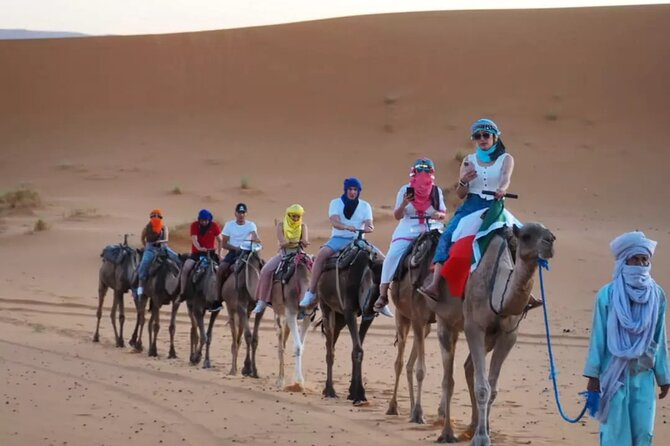
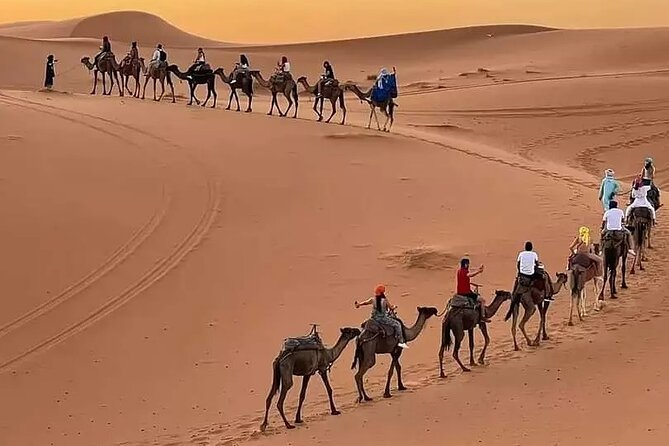
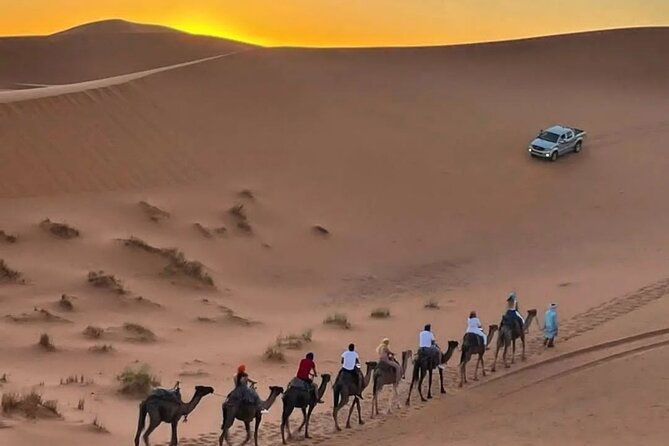
You ride dromedaries for about an hour through the dunes, with time to reach the desert’s core and watch sunset. Once night falls, you gather for camp dinner, Moroccan tea, and drum rhythms, then sleep in your luxury desert tent.
Two practical details you’ll appreciate:
- Sandboarding is included, so you’re not limited to slow sunset photos.
- There’s a 4×4 transfer option described as an alternative to camels. If you want the dunes feeling but prefer less time on the camel, you have a built-in way to manage comfort.
This night also changes your pace. You’ll likely feel it in the dark: fewer decisions, more watching the sky, and less time worrying about where your next stop is. For a first-time Morocco visitor, it’s often the most memorable contrast after days of medina walking.
Rissani, Todra Gorge, and Dades Valley: markets, stone cliffs, and fig-country vibes
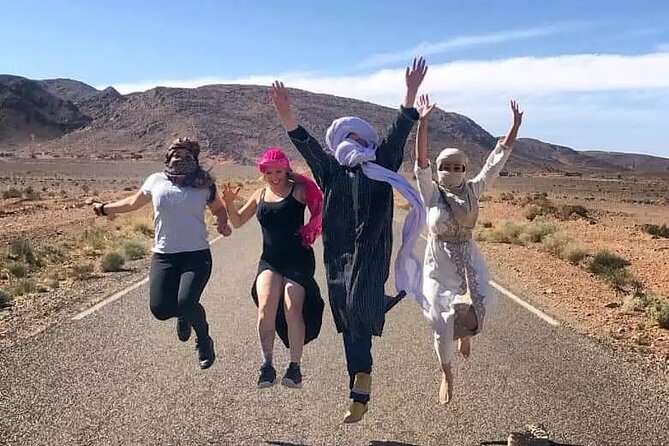
Day 5 moves you from the desert zone toward the next stretch of sights.
In the morning, you do a sunrise show, then return to the hotel for shower and breakfast before leaving the dunes. After that, you head to Rissani, including a stop at the town market. The plan calls out that market days can line up with Tuesday, Thursday, or Sunday, so timing can vary—but the idea stays the same: a real market atmosphere tied to historic routes.
Then you go to Todra Gorge, known for vertical rock walls formed by the river bed. The route includes lunch on site and a recommended walk. If you like dramatic scale, Todra delivers. Also, it’s a nice switch from sand and city texture to something colder-feeling and stone-sturdy.
In the afternoon you continue to the Dades Valley, also called the Valley of the Figs, with a stop at monkey’s paws. This section is more about viewpoints and short pauses than long museum time, so bring comfortable shoes and expect quick photo stops.
Ouarzazate, Skoura palms, Aït Benhaddou, then up and over the Atlas into Marrakech
Day 6 is another “big driving day,” but it’s packed with the kinds of stops that make the long hours worth it.
You pass through Skoura and the Valley of Roses area (at least as the driving route frames it), then explore a palm grove in Skoura. From there you continue to Ouarzazate, where you can visit the Kasbah of Taourirt. If film history interests you, the route also mentions film studios where movies were shot.
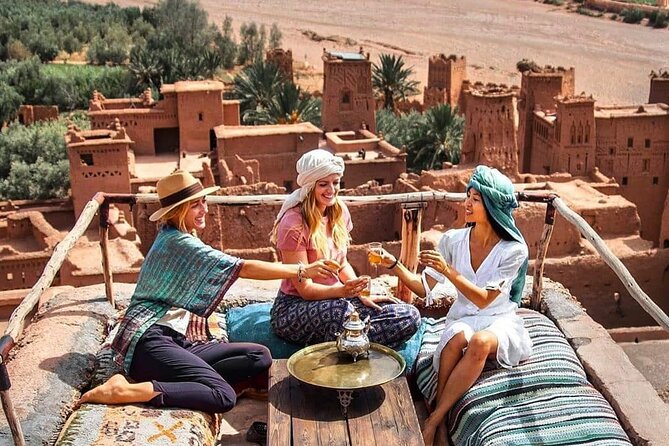
After Ouarzazate, the plan takes you to Aït Benhaddou, described as one of the largest kasbahs in southern Morocco. You’ll be able to walk through its streets and climb for valley views. This is one of those places where the effort pays off: from higher points, you understand why filmmakers like this setting.
Then you cross the High Atlas on a mountain pass near 2,300 meters and drive toward Marrakech. Arriving late enough that the day ends around Jemaa el Fna Square can be magical, because the evening energy is part of the Marrakech experience.
Marrakech medina time: Jemaa el Fna, Saadian Tombs, Bahia Palace, and Koutoubia

Day 7 is a concentrated Marrakech sightseeing day with breakfast and about four hours of sightseeing in the medina.
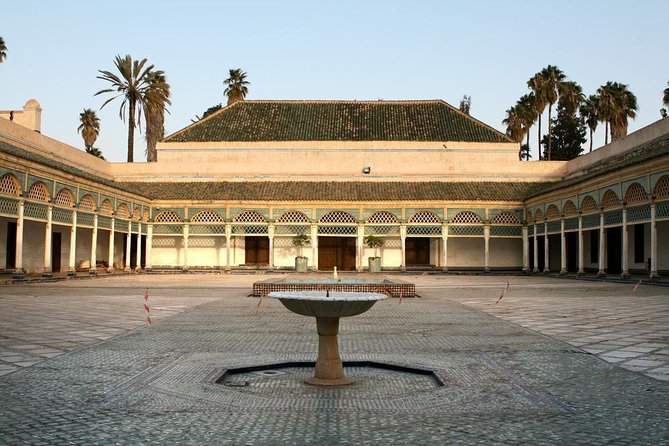
The big anchor is Jemaa el Fna, which fills your time with aromas, sounds, and street energy. Beyond that, the route highlights key stops: Saadian Tombs, Koutoubia Mosque, and Bahia Palace, plus walking time through the mellah (the old Jewish quarter) and other medina areas.
A practical tip: plan to feel a little torn between slow wandering and taking in named sights. This day is structured, but Marrakech still rewards detours—especially if your guide helps you pick which alleys to explore first.
Since entrance fees are listed as not included, expect to pay separately if you choose to go into specific sites.
Price and logistics: does $1,349.08 feel worth it?
At $1,349.08 per person for a roughly 7-day coast-to-Sahara-to-Marrakech route, the question is what you’re buying besides transportation.
Here’s what’s clearly part of the package:
- Air-conditioned vehicle and private transportation
- English–Spanish speaking driver/guide
- Pickup from Tangier and drop-off in Marrakech at a nearby accessible spot to your riad or hotel
- Six nights in riads
- One night in a luxury desert tent
- Camel ride, plus sandboarding
- 4×4 transfer alternative to camels
- Guided sightseeing tours of Fes and Marrakech
- Breakfasts (6) and dinners (2) included
What’s not included:
- Lunches and dinners in Chefchaouen, Fes, and Marrakech
- Drinks
- Optional entrances and tipping
So yes, it’s not a cheap throw-in. But it’s also not overpriced if you compare it to the cost of piecing together separate guides, desert camp nights, and riads on your own. You’re paying for the structure: fewer coordination hassles, planned sightseeing time, and an included desert night with activities.
One budgeting note: if you want to avoid surprise fees, you’ll want to estimate museum/ruins entrances you may pay for on top of the tour.
Who this tour suits best
This works best if you want:
- A first-time-friendly route that connects Tangier, Chefchaouen, Fes, the Sahara, and Marrakech without needing multiple separate bookings
- City guidance where it matters most (Fes and Marrakech)
- A desert night that feels like an experience, not just a drive-by
It may not be ideal if you:
- Hate long drive days (even though the scenery stops break it up)
- Need every meal included and fully predictable costs
Should you book this Tangier to Marrakech tour?
I’d book it if your goal is variety with structure: blue streets, imperial cities, desert dunes, and Marrakech all in one week. The best argument for this trip is the combo of riad comfort, a real desert camp night, and guided time in Fes and Marrakech, all with a small group size.
If you’re the type who likes to control every single entry fee and meal choice, you might feel the “not included” parts as extra work. But if you’re okay budgeting for lunches, drinks, and a few optional entrances, this is a strong value way to see a lot of Morocco without turning the week into logistics.
FAQ
What time is pickup on the first day?
Pickup is offered from your hotel in Tangier at 8:00 am on Day 1.
How long is the tour?
The tour runs for 7 days (approx.).
What is the group size limit?
It’s a group tour experience with a maximum of 17 people, and it’s private in the sense that only your group participates.
Is there a camel ride and desert camp included?
Yes. You get a camel ride through the dunes and one night in a luxury tent at a traditional desert camp.
Is sandboarding included?
Yes. Sandboarding in the dunes is included.
What about transport to and from the desert camp?
The tour includes 4×4 transfer from and to the camp as an alternative to camels.
Are meals and entrance tickets included?
Breakfast is included for 6 days, and 2 dinners are included. Lunches and dinners in Chefchaouen, Fes, and Marrakech are not included, and some entrances are also not included (for example, Volubilis).
What’s the cancellation rule?
You can cancel for a full refund if you cancel at least 24 hours before the experience’s start time.